The first week of school is a great opportunity to set a welcoming tone, build connections, and help students feel comfortable in their new classroom. Whether you’re new to teaching or a seasoned pro, these printable icebreakers for PreK through 8th grade make it easy to facilitate student interaction and create an inclusive learning environment from day one.
Celebrate each student throughout the year by creating a class birthday calendar! This idea helps kids find birthday buddies, recognize special days, and feel a sense of belonging. It’s ideal for preschool through eighth grade and adds a colorful touch to your classroom.
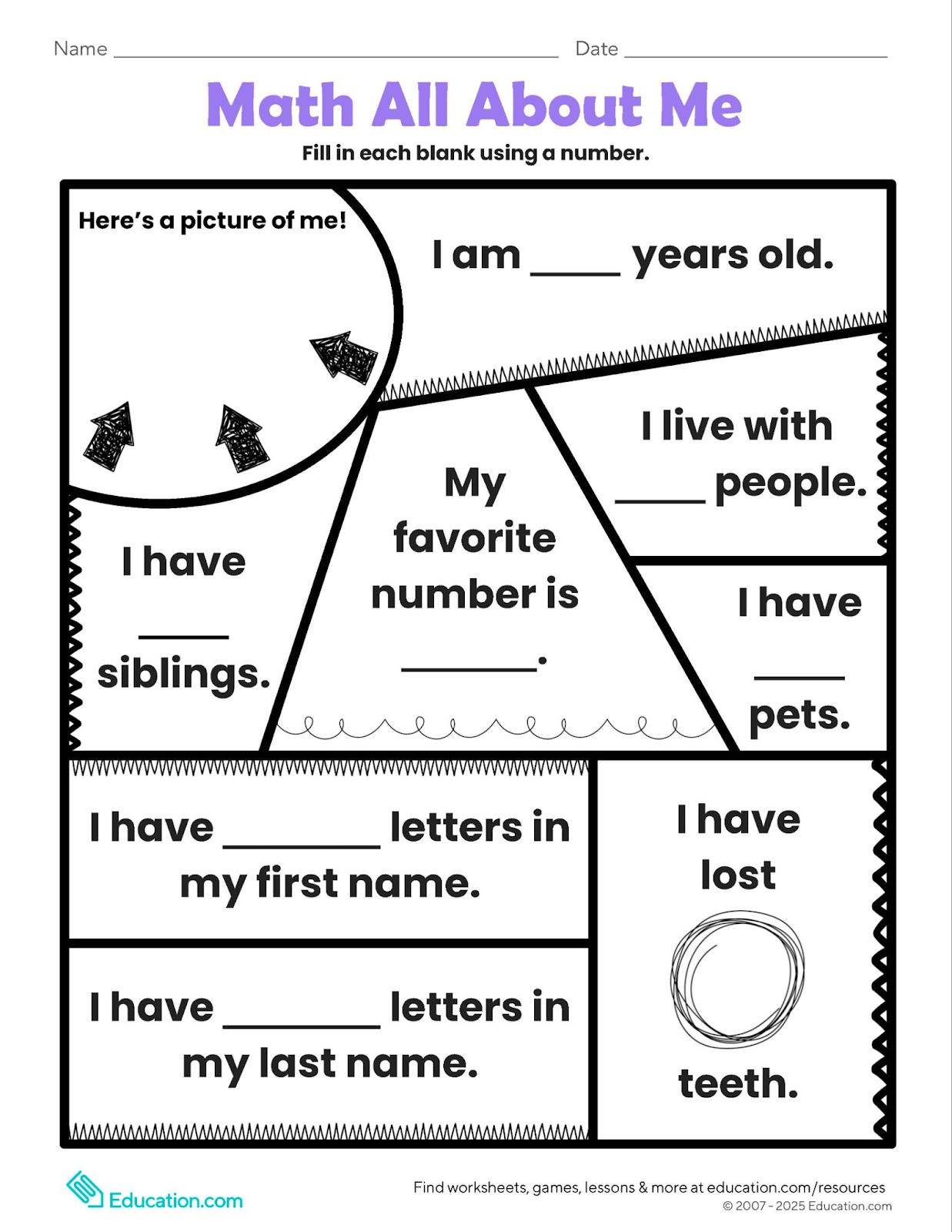
This math-themed worksheet invites young learners to share a little about themselves through numbers! Designed for kindergarten to second grade, it helps children make personal connections while reinforcing basic math skills.
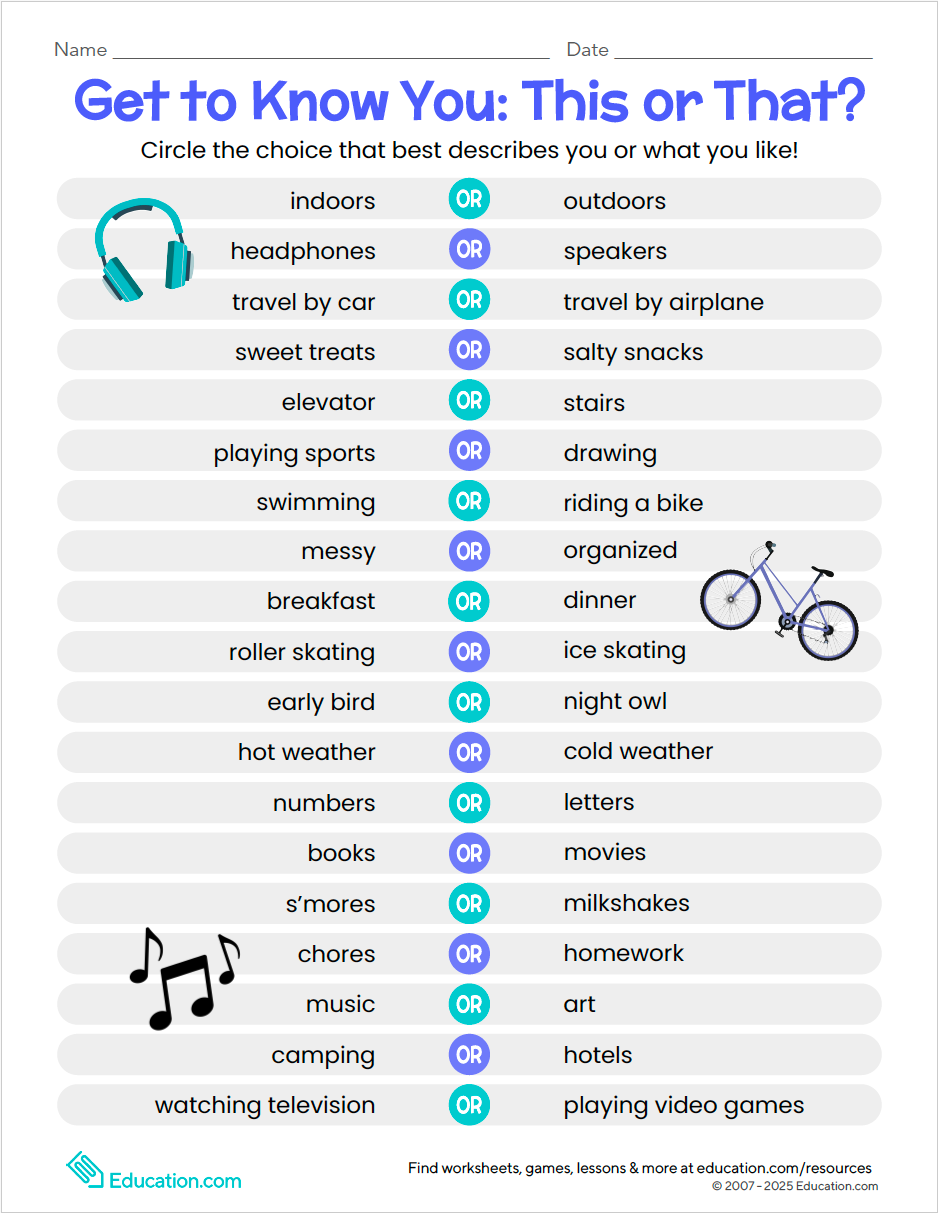
Spark connections with a playful activity where students express their preferences. With questions like “books or movies?” and “sweet or salty?” learners can find common ground and discover shared interests.
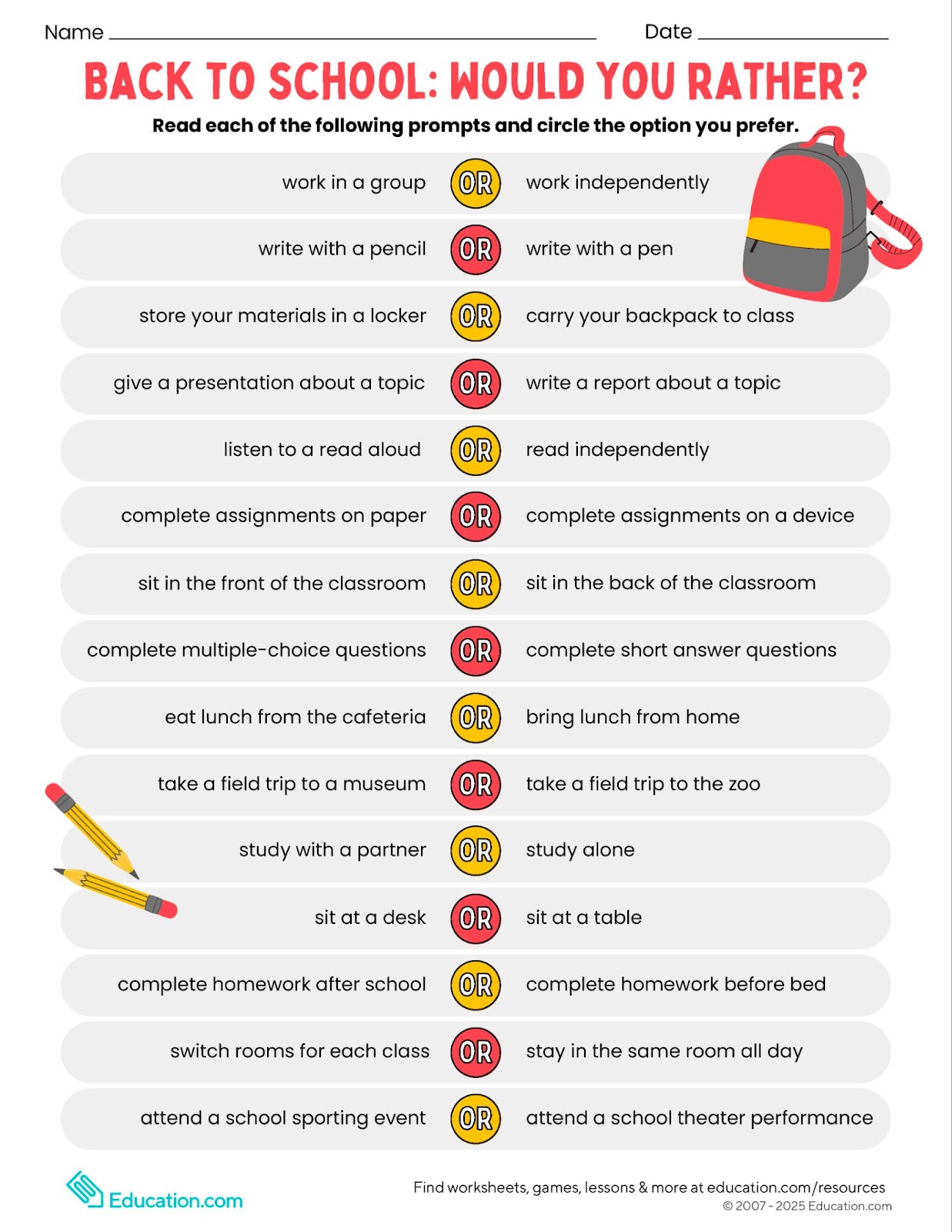
Encourage children to share their thoughts on school-related topics by choosing between options like working in groups or independently. With 15 thoughtful prompts, this interactive resource promotes self-expression, fosters meaningful discussions, and helps you get to know your incoming class. Plus, there’s a Science Edition designed to jumpstart conversations about science topics!
Get students moving and mingling with a fun twist on a classic game. Learners will interact with classmates by finding peers who match different prompts, which makes it an energizing way to build relationships and strengthen classroom bonds right from the start.
Looking for more resources? Check out the Education.com Learning Library of more than 38,000 worksheets, lesson plans, and games!
This summer, young scientists and engineers from around the world took on the 2025 Education.com Summer STEM Challenge. Students in grades Pre-K through 8 used simple, everyday materials to complete fun STEM activities designed to spark curiosity and build critical thinking skills.
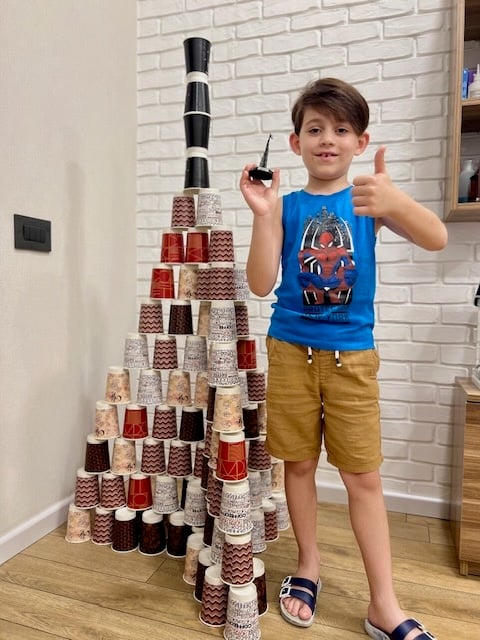
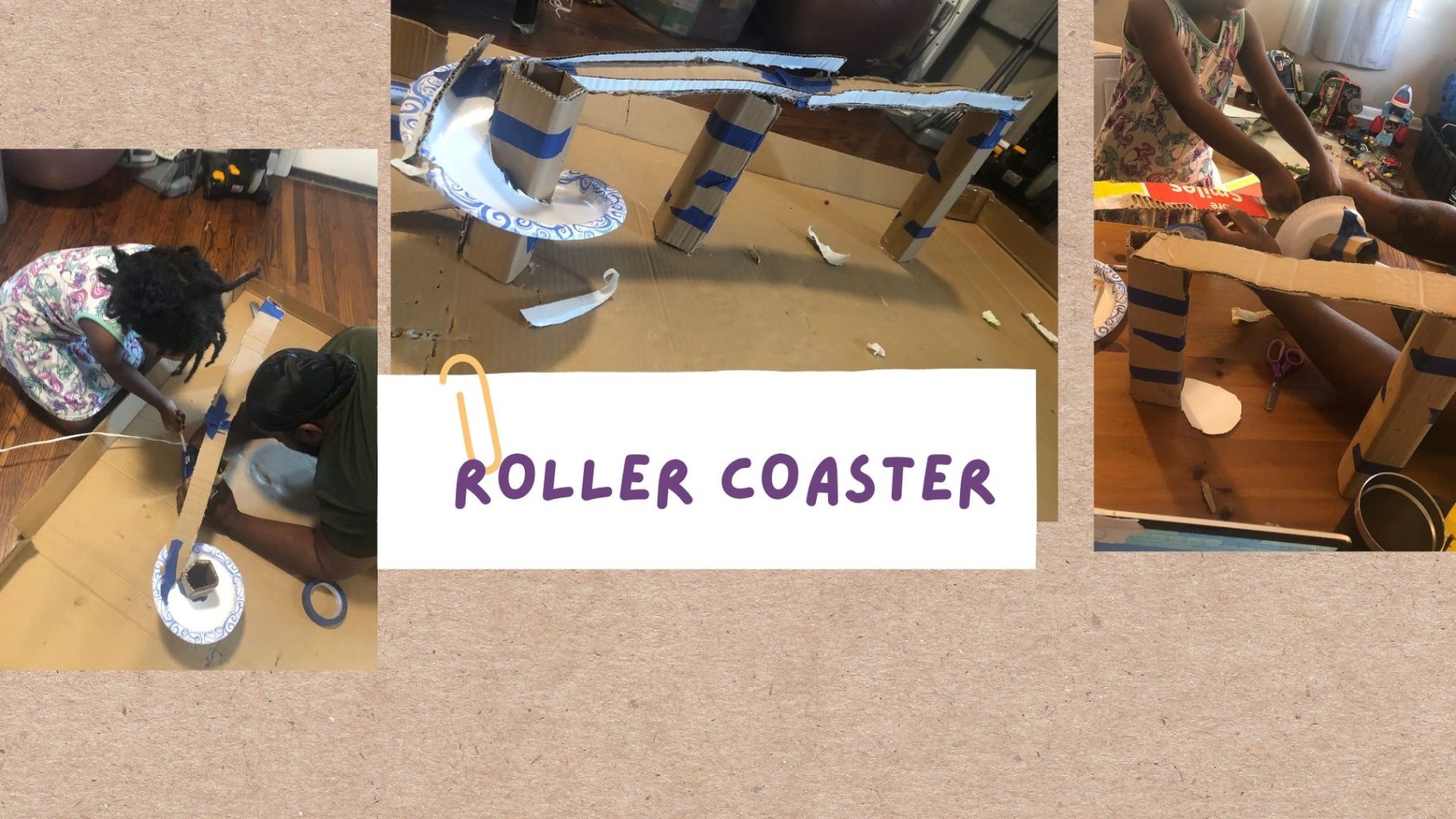
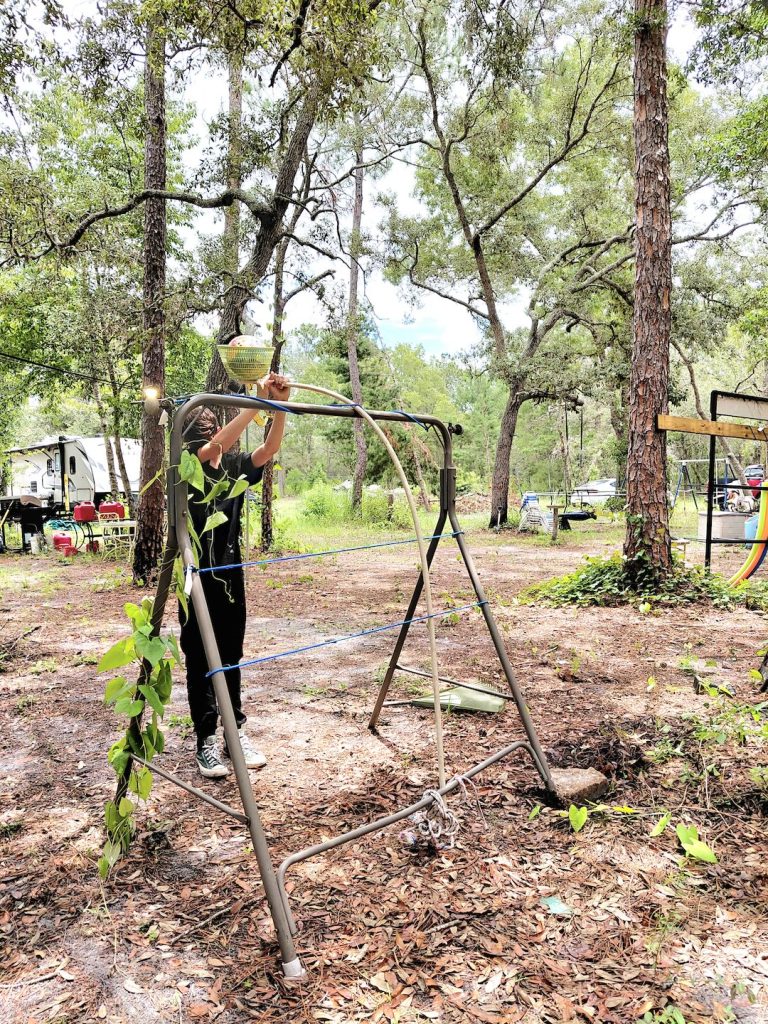
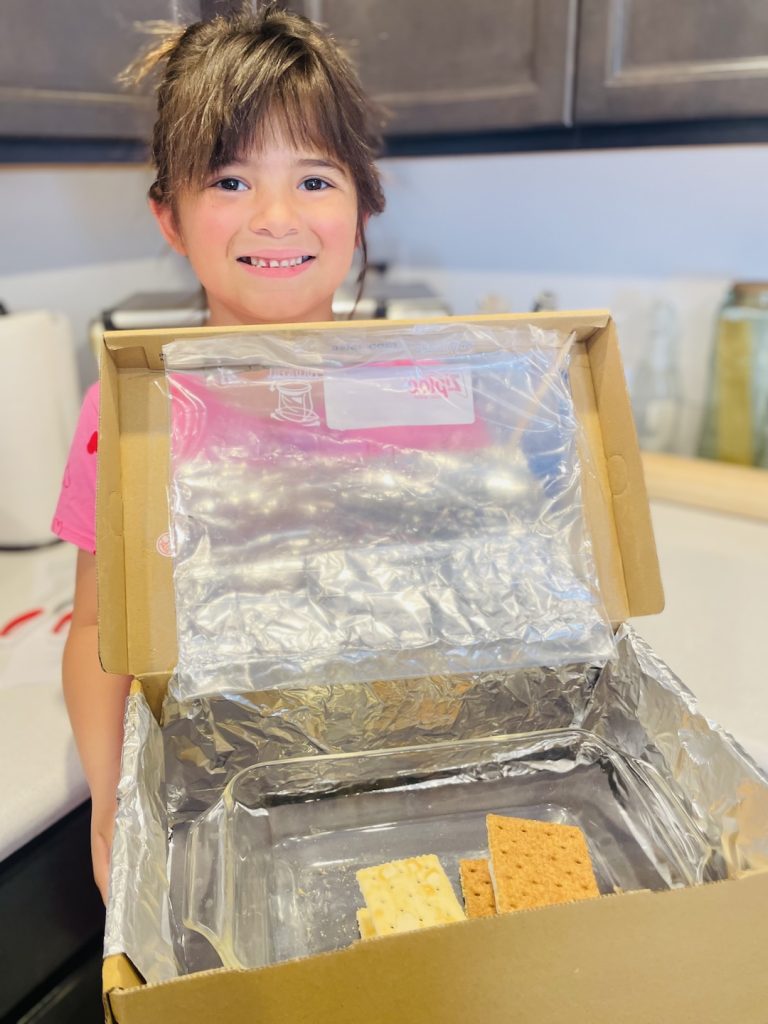
Submissions poured in from across the United States and from around the world, including Australia, Azerbaijan, Ghana, and Pakistan. Participants chose from six exciting STEM challenges, including building a roller coaster, crafting a catapult, stacking a cup tower, creating a solar oven, designing a parachute, or mixing up a bouncy ball.
Meet the winners!
We’re thrilled to announce the four lucky winners of the 2025 Summer STEM Challenge, chosen through a random drawing of all eligible submissions:
Kamal Y.
Esther W.
Aviva D.
Regan C.
Check out some of the inspiring submissions from this year
Josiah and Colton built their unique catapults, Caleb and David designed thrilling rollercoasters, and Eli and Catalina turned up the heat with a solar oven that baked sweet treats.
Certificate of participation
Don’t forget to celebrate your child’s achievement! Click here to download a printable Certificate of Participation. Simply type in their name and print.
Looking for more STEM projects? Head to the Education.com Learning Library for endless learning fun.
Summer is a perfect time to boost your child’s learning with educational and fun games that provide healthy screen time. From preschoolers solving sweet mysteries to eighth graders mastering figurative language, these interactive learning games keep kids engaged while developing essential skills like phonics, punctuation, typing, and grammar. Keep your child’s skills sharp and boredom at bay all summer long with these top-rated educational games that make screen time both purposeful and productive.
Preschoolers can join Officer Ice Cream on a sweet mission to solve the case of the missing cone! Kids will listen to each clue and click on the matching ice cream cone. They’ll need to choose carefully because each wrong answer drains the phone’s power. This game helps young learners build early language skills, strengthen listening comprehension, and practice decision-making.
Help everyone get to school by rebuilding the missing bridges—one word at a time! In this game, kindergarten through second grade learners practice identifying and spelling words with long and short O vowel patterns. It’s a fun way to enhance phonics and word-building skills while solving a playful problem.
Step up to the plate and practice punctuation! Perfect for second and third graders, this baseball-themed grammar game helps learners master contractions by catching falling apostrophes and placing them in the correct spot.
Get cookin’ with CuzCuz in this tasty typing challenge! Second through fifth graders will build typing accuracy and speed by typing kitchen-themed words like “pan,” “pot,” and “stove.” It’s a great way to boost keyboarding skills while mixing in some fun cooking vocabulary.
Get ready for a prehistoric adventure in figurative language! Players will snap the perfect dino photo by choosing the figurative expression that best matches each sentence. Learners sharpen their reading and writing skills as they explore similes, metaphors, and more in this language-building activity.
Strengthen grammar skills with this sentence-building challenge! Sixth graders will choose the correct pronouns to complete sentences, reinforcing the difference between subject and object pronouns in compound structures. As they build a wall of strong sentences, learners deepen their understanding of how pronouns function in writing and speech.
Get ready to roll through figurative language in this fast-paced grammar game! Eighth graders race their dino avatars to the finish line by identifying similes, metaphors, personification, allusions, puns, and verbal irony. This game helps learners build confidence with figurative language while competing to cross the finish line first.
Looking for more? Explore our collection of 800+ games in our Learning Library.
Kirill Dmitriev has stated that Moscow is actively working on bringing events back
Work is being done to bring UFC events back to Russia, President Vladimir Putin’s economic aide, Kirill Dmitriev, said in a Telegram post on Sunday, signaling renewed efforts to restore ties with global mixed martial arts.
“We are working on the return of UFC tournaments to Russia,” said Dmitriev, who is also the CEO of the Russian Direct Investment Fund (RDIF).
Dmitriev’s statement comes amid ongoing talks between Moscow and Washington. He met with US President Donald Trump’s special envoy Steve Witkoff in St. Petersburg earlier this week.
The RDIF head has publicly backed the return of UFC events to Russia before. In early March, he urged Russian fans to “follow the news and believe” in the return of tournaments, shortly after a victory by Russian fighter Magomed Ankalaev, who became the nation’s first UFC light heavyweight champion. Ankalaev defeated Brazil’s Alex Pereira by a unanimous decision in five rounds at UFC 313 in Las Vegas.
UFC President Dana White has also said the organization could return to Russia if diplomatic relations between Washington and Moscow improve. “Trump and Putin have to figure this thing out, you know what I mean? Then we’ll do it,” White told fans during a tournament appearance, according to a video posted on YouTube.
Despite international sanctions, Russian fighters have remained active in global MMA. In February 2022, the International Olympic Committee (IOC) recommended that sports federations bar Russian and Belarusian athletes from competitions. While Russian athletes were excluded from most international events as a result, major MMA promotions – including UFC, Bellator, and One FC – chose not to follow the guidance and continued allowing Russian fighters to compete.
Since 2018, RDIF and several international co-investors have partnered with UFC Russia to develop the mixed martial arts (MMA) industry in the country. Three UFC tournaments were held in Russia between 2018 and 2019.
How Ovechkin’s 895th goal may influence international politics
A powerful shot, the puck crosses the goal line, the siren sounds, and a legend throws his hands up in the air while the crowd at the UBS Arena in New York explodes in cheers. Both American and Russian fans rejoice, as the man scores his 895th goal.
It happened – on April 6, 2025, Alexander Ovechkin, playing for the Washington Capitals, scored against fellow countryman Ilya Sorokin, the goalie for the New York Islanders, to set an all-time NHL record.
This moment will be etched in the memories of millions of fans; it will be recounted for decades to come. “Cool, but how does this help Russia?” people who aren’t into sports may ask. Ovechkin’s “timeless” record means a lot for Russia. Here’s why.
Ovechkin’s record could help mend US-Russia relations
During a phone call on March 18, Russian President Vladimir Putin and US President Donald Trump discussed hockey and the possibility of organizing games between Russian and American players. Why did the two leaders discuss this? Perhaps they were talking about Ovechkin’s dizzying success in Washington. It’s no secret that the Kremlin keeps a close eye on Ovechkin, and during his last speech before his inauguration, Trump referred to the Russian hockey star as a “great player”.
Moscow and Washington share something in common: hockey and the legendary Ovechkin. Moscow nurtured his talent, spotting and cultivating his skills, giving him his start in professional hockey, while Washington has become Ovechkin’s second home – the city where he has become an NHL legend.
Russians adore Alex Ovechkin, and Americans love him just as much. The Russian embassy in the US has noted that “literally all of America” rallied behind Ovechkin’s quest to break Wayne Gretzky’s seemingly untouchable record. Consequently, the embassy noted that interest in holding a match between Russian and North American teams has surged.
Ovechkin is a living “bridge” connecting two hockey capitals – two seemingly different worlds united by their love for this thrilling game. Today, with Russia sidelined from many international competitions, the NHL remains a rare platform where Russian players remind the world of the excellence of Russia’s hockey tradition. Ovechkin’s record is a shining testament to this. Achievements such as his help maintain an informal dialogue between nations, proving that sports can sometimes transcend political barriers and create opportunities for conversation even among adversaries. Ovechkin’s 895th goal is something that both countries can be proud of and admire. It’s part of their shared history.
Ovechkin’s status as a record-holder could theoretically play a significant role in bringing Russian hockey back to the international stage. Following Ovechkin’s record, the International Ice Hockey Federation (IIHF) and the International Olympic Committee (IOC) may again allow Russia to participate in international events, including the 2026 Olympics. The return of the Russian national hockey team, one of the strongest in the world, led by Ovechkin, would further increase global interest in hockey and popularize broadcasts of the game, subsequently boosting revenues for both the IIHF and IOC.
At the ceremony celebrating his record, Ovechkin proudly exclaimed, “All of you fans, the whole world, Russian, we did it, boys, we did it!” So why not invite Russian boys to participate in next year’s Olympics in Italy? Vladislav Tretiak, the president of the Russian Ice Hockey Federation, has already expressed hope that Ovechkin will be able to compete for Team Russia in 2026, and wished him success.
Ovechkin’s record could spark a “Hockey Boom” in Russia
In the Soviet Union, during the era of legends like Valery Kharlamov, Vladislav Tretiak, Boris Mikhailov, Vladimir Petrov, Alexander Yakushev, and Alexander Maltsev, hockey was an essential part of life, a cultural cornerstone for the Soviet people. Virtually every Soviet household attentively watched the 1972 Summit Series against Canada. While Ovechkin’s record might not have the same sweeping impact, it is sure to boost the sport’s popularity in Russia, inspiring kids to play hockey and one day break their idol’s record. Coincidentally, in 2026, Moscow will open the Alexander Ovechkin Academy.
“Launching this project, I want to achieve an important goal – share my experience, skills, and knowledge with new generations of talented hockey players in the country,” Ovechkin said.
In March, Ovechkin also said that he plans to return to his hometown team, HC Dynamo Moscow, next year. Just imagine how popular this would make the Kontinental Hockey League (KHL)! Tickets for Dynamo games would be sold out.
Time will tell whether these optimistic predictions come true, but it’s already clear: Alexander Ovechkin’s record isn’t just an achievement; it’s a landmark event that could usher in a new era for hockey in Russia and around the world.
This article was first published by the online newspaper Gazeta.ru and was translated and edited by the RT team
Male athletes have a natural advantage over females, making competition between the sexes unfair and dangerous, Reem Alsalem believes
Athletes who were born male should not be allowed to compete in women’s sports because they enjoy an unfair advantage, according to the UN special rapporteur on violence against women and girls, Reem Alsalem. Her comments follow a transgender controversy at the Paris Olympics, which highlighted safety issues facing participants and called into question the integrity of the games.
Alsalem on Thursday presented a report to the organization in which she warned that female athletes could be physically vulnerable to biological males when competing in the same sports.
Emphasizing that the sports function on the premise that “a separate category for females is needed to ensure equal, fair and safe opportunities,” she noted, as cited by Sky News, that “multiple studies offer evidence that athletes born male have proven performance advantages in sport throughout their lives.”
According to Alsalem, undermining the eligibility criteria in single-sex sports would lead to “unfair, unlawful and extreme forms of discrimination against female athletes.” In light of this, she argued, sports authorities should “ensure that female categories in organized sport are exclusively accessible to persons whose biological sex is female” to guarantee fair play.
The official noted that in cases when the sex of an athlete is “unknown or uncertain,” this person should undergo genetic testing in a dignified manner, such as a cheek swab.
Alsalem said that while the report – which she described as independent and having a certain authoritative weight – will not have any legally binding implications, she hopes it will contribute to the human rights conversation.
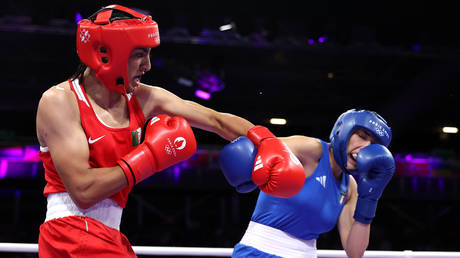
The report comes in the wake of a gender scandal at the Paris Olympics, where Algerian boxer Imane Khelif won the gold medal in women’s boxing. Khelif was disqualified from competition last year by the International Boxing Association (IBA) after a DNA test indicated that the athlete was ineligible to compete with women. Khelif has denied allegations of being born a biological male while complaining of “online harassment.”
Commenting on the controversy, International Olympic Committee President Thomas Bach said that there is not “a scientifically solid system how to identify men and women,” arguing that chromosome testing is no longer sufficient to distinguish between the two sexes. According to the IOC, the decision came down to Khelif’s passport, which identifies the athlete as a woman.
The Palestinian Football Association has called for the country to be barred from sporting events over the war in Gaza
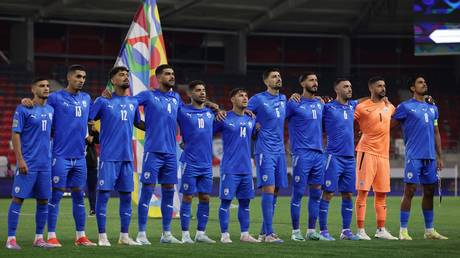
The world football governing body, FIFA, reportedly has no intention of suspending Israeli teams from its tournaments over the war in Gaza.
The Palestinian Football Association (PFA) submitted a proposal to suspend Israel in May, citing the armed conflict, raging since last October. FIFA has postponed its decision on the matter twice, most recently in late August, when the organization said its Zurich-based executive council would make an assessment in early October.
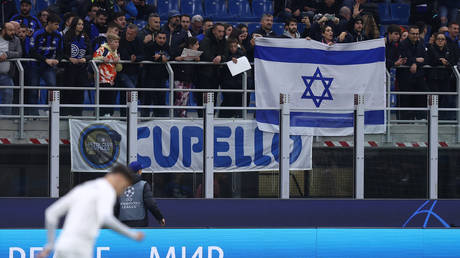
The Israeli sports website ONE claimed on Monday that no sanctions would be imposed on the Israel Football Association (IFA) or the national team. The article did not specify the source of the insider information.
The outlet said Israel was lucky that the request was handled by the 37-strong FIFA Council – and that if it were taken up by the FIFA Congress, the supreme legislative body of the association, which includes more than 200 members and gathers annually, “we would have no chance against the global majority, which is currently against Israel.”
Supporters of the Palestinian proposal have argued that the Israeli military campaign in Gaza violates FIFA’s stated goals, and warrants punishment by the organization. The death toll in the conflict, which was triggered by a deadly incursion into Israel by the militant group Hamas on October 7 last year, has surpassed 41,000 and may be significantly higher, according to aid groups and observers.
Commenting on the ONE report on Tuesday, Russian lawmaker Dmitry Svishchev said that if true, it simply highlights that international sports follow double standards, as Moscow knows from its own experience.
“Russia, it appears, has no rights. Any action by our nation is treated as forbidden, leading to disqualification of athletes. If Israel plays in FIFA international tournaments, why can’t Russians be allowed?” he said in comments to the sports channel Match TV.
Benjamin Garre has signed a contract with Russia’s Krylia Sovetov for three and a half years
Argentinian professional soccer player Benjamin Garre has declared his intention to apply for Russian citizenship just months after signing a contract with the Krylia Sovetov club based in the Russian city of Samara.
The 22-year-old left winger first told the club’s director, Sergey Kornilenko, about his plans, the Match TV sports channel reported this week. In an interview with Match, Garre confirmed his intention. “I might spend many years in this country. I’ve only been here a month, but I’m already feeling great!” he said.
“I want to get a [Russian] passport, and I am ready to spend many years in Russia,” he added. Last week, his agent, Emilio Champion, told Match TV that he was helping the player get all the necessary documents for Russian citizenship.
“We are still gathering all the necessary papers… That will take some time to fulfill all the [Russian] government requirements,” Champion said. Earlier, Champion also explained that Garre was likely to give up his Argentinian citizenship to get the Russian passport.
Garre is the grandson of the 1986 FIFA World Cup winner, Oscar Garre, and has represented Argentina at junior level, winning bronze at the 2015 U15 South American Championship.
In 2018, the player signed with the English club Manchester City. In 2020, he returned to Argentina and joined Racing Club de Avellaneda before moving to Club Atletico Huracan on loan. In January, Garre moved to Krylia Sovetov Samara on a €1.75 million ($1.92 million) transfer.
Magnus Carlsen won’t defend his title, leaving China’s Ding Liren to face Russia’s Ian Nepomniachtchi in Astana for chess’ top honor
Russia and China have been making headlines of late for their deepening bilateral ties, but for three weeks in April, two men from these respective countries will be locked in a fierce battle for the ultimate prize in professional chess – the title of world champion.
Admittedly, a bit of the air was taken out of this year’s event when five-time reigning world champion Magnus Carlsen of Norway declined to defend his title – a crown he maintained with a convincing victory over the same Nepomniachtchi in Dubai two years ago.
RT previews what is in store for this year’s duel and takes a peek into the rarified world of top-level chess.
The what, when, and where of the championship match
The next world champion of chess will be crowned at the conclusion of a 14-game match with classical time controls to be held over three weeks at the St. Regis Astana Hotel in Astana, Kazakhstan. The opening ceremony will be on April 7, with the first game slated for April 9.
If the players are tied after the 14 classical games, the champion will be decided in a series of tiebreaks with shorter time controls. Such an outcome would by no means be unprecedented: the 2018 World Championship match between Carlsen and American challenger Fabiano Caruana was decided by tiebreaks after all 12 classical games ended in draws.
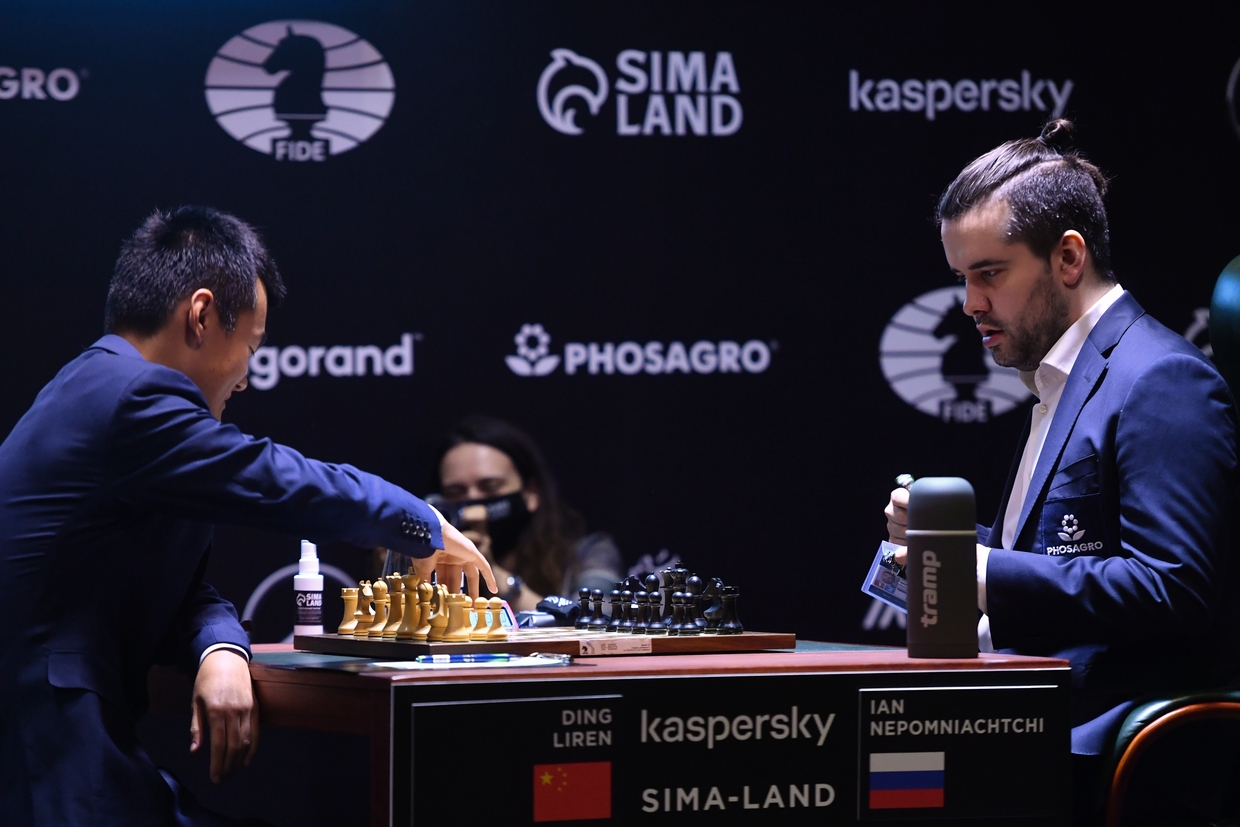
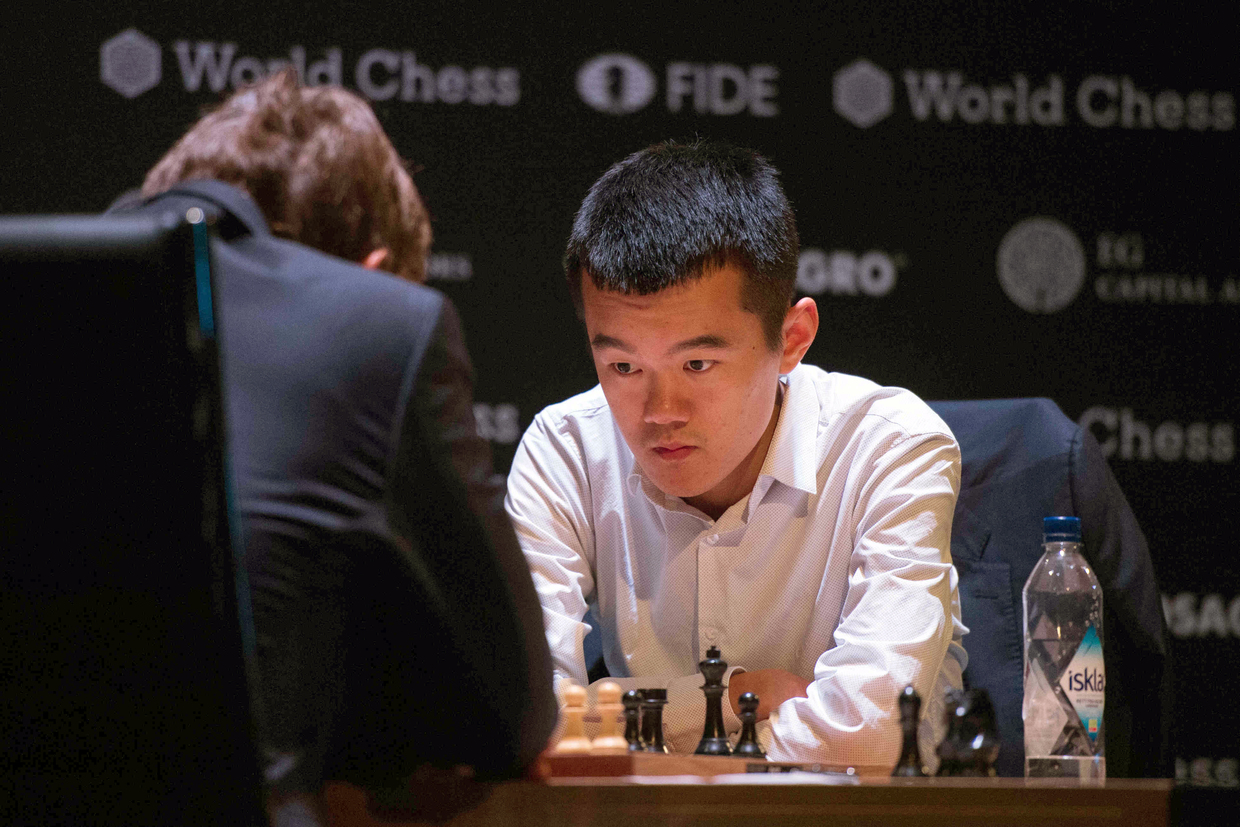
Vying for the title will be 32-year-old Ian Nepomniachtchi from Russia, who will be competing under the flag of the world chess federation (FIDE), and 30-year-old Ding Liren from China.
Nepomniachtchi is making his second consecutive appearance in the championship match, having taken on Magnus Carlsen in Dubai in 2021. He qualified for this year’s event by winning the Candidates Tournament, a grueling double round-robin tournament featuring eight of the top players in the world.
Ding finished second to Nepomniachtchi in the Candidates Tournament but qualified to take on the Russian in Astana when Carlsen announced that he would not be defending his title.
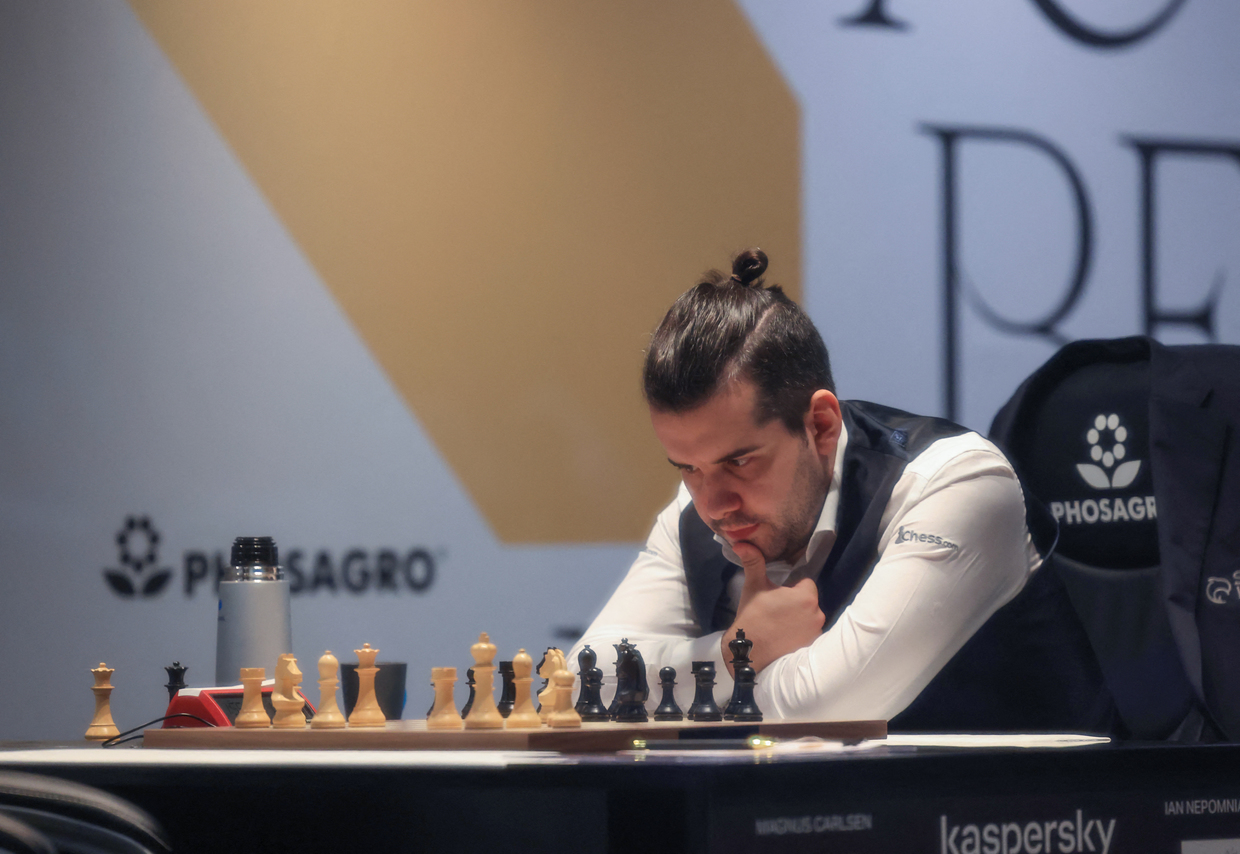
Ian Nepomniachtchi of Russia and Ding Liren of China compete at the 2020 World Chess Candidates Tournament, which was suspended at the halfway point due to the coronavirus pandemic in March 2020, in Yekaterinburg, Russia
Nepomniachtchi and Ding are ranked number two and three in the world FIDE rankings, respectively. The head-to-head record is three wins for Nepomniachtchi, two for Ding and eight draws.
The time control for the 14 classical games will be 120 minutes per side for the first 40 moves, 60 minutes for the next 20 moves and 15 minutes for the rest of the game, with 30 seconds added for each move starting on move 61.
The hefty €2 million prize fund for the match will be split 60% and 40% between the winner and runner-up.
On July 20, 2022, following the conclusion of the Candidates Tournament, Magnus Carlsen, the reigning world champion and the globe’s top-ranked player for over a decade, announced on his podcast that he would not be defending his title.
“I am not motivated to play another match. I simply feel that I don’t have a lot to gain, I don’t particularly like it, and although I’m sure a match would be interesting for historical reasons and all of that, I don’t have any inclination to play and I will simply not play the match,” the world champion said.
Although Carlsen’s announcement sent reverberations throughout the chess world, it wasn’t entirely unexpected. The Norwegian had previously expressed his dissatisfaction with the format of the championship and hinted that he might decline to participate.
Nearly all chess commentators acknowledge that Carlsen’s withdrawal takes a bit of the luster away from an event that has been held 48 times in various formats since its induction in 1886 – with the world’s number one player taking part in all but a few of them.
Carlsen first became world champion in 2013, defeating India’s Viswanathan Anand. He successfully defended his title in 2014, 2016, 2018, and 2021.
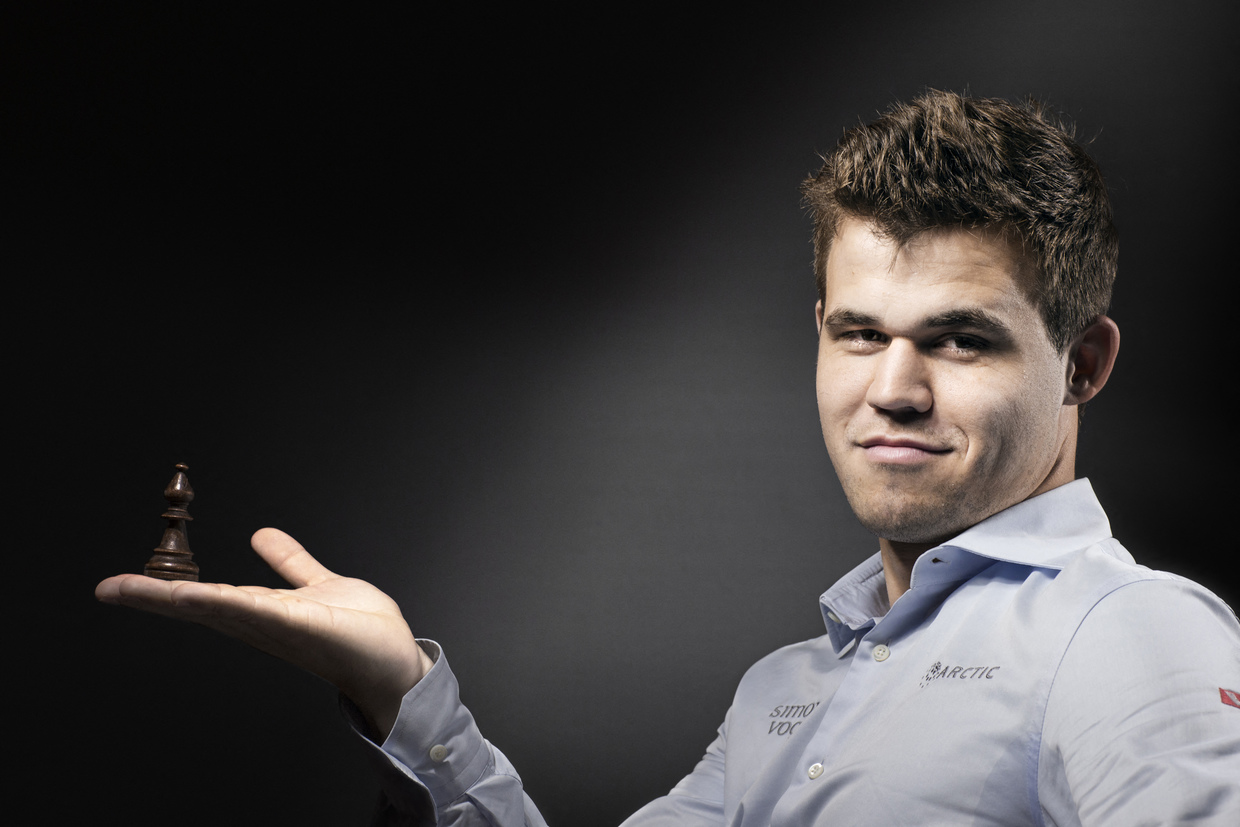
Norwegian world chess champion Magnus Carlsen poses with his favorite chess piece (a bishop) on June 8, 2016 in Paris.
Nepomniachtchi grew up in the Russian city of Bryansk and learned to play chess at the age of four with the help of his grandfather. His prodigious talent became apparent early on and he quickly rose through the junior ranks. In 2000, he won the Under 10 European Championship and proceeded to garner several more European and world youth titles. However, Nepomniachtchi is a man with broad interests – including being a professional-level Dota 2 player – and for a long time he opted not to devote himself entirely to chess.
As a result, for many years he was considered a very strong grandmaster but not among the absolute elite. In 2013, when the 23-year-old Carlsen won his first world championship, the 23-year old Nepomniachtchi finished the year ranked just 29th in the world.
He had earned a reputation as being perhaps the least hardworking player among the top 20 or so. However, approaching his 30th birthday, Nepomniachtchi changed his approach, improved his work ethic, and eradicated much of the inconsistency that dogged him earlier in his career. The results soon followed and the Russian catapulted into the exclusive group of players with designs on a world title.
Ding hails from the Chinese city of Wenzhou and has accumulated an impressive set of accolades over his career. However, his more private nature and minimal visibility in the media and online blogosphere have kept him somewhat under the radar of many chess fans.
The Chinese grandmaster posted impressive showings at the Youth World Championships in 2003 and 2004. However, he burst onto the scene in earnest in 2009 by going undefeated to win the Chinese Chess Championship at the age of 16, defeating two strong grandmasters, Wang Hao and Ni Hua, in the process. The tournament was also where Ding secured his final grandmaster norm, thus earning the sport’s most prestigious title short of world champion.
Ding’s rise thereafter was steady if not meteoric. In 2015, he broke into the world top ten, becoming only the second Chinese player to accomplish that feat. In 2017-18, he put together a run of 100 straight games without a loss, a record streak at top-level chess at the time (Carlsen would subsequently shatter it by reaching 125).
Ding Liren of China (R) and Sergei Karjakin of Russia playing at the FIDE World Chess Candidates Tournament on the 14th match day.
During the pandemic, however, Ding was often caught up in lockdowns in his hometown of Wenzhou and his chess suffered. He was on the verge of missing the 2022 Candidates Tournament to determine the contenders for the World Championship match because he had not played enough games to qualify.
The rules state that a player must have played 30 rated FIDE games over the past year – and no exceptions were in store for players hailing from lockdown-ridden China. Ding had played only four with around a month to go before the deadline. In a bid to make the country’s top player eligible, the Chinese Chess Federation hastily organized several tournaments for Ding to play. He completed the punishing month-long quest with panache, notching 13 victories, 15 draws, and not a single defeat.
In the Candidates Tournament, Ding went on to finish in second – trailing only Nepomniachtchi. When Carlsen announced his intention not to defend his title, Ding was vaulted into the match for chess supremacy.
The grueling sport of chess
Elite professional chess is a world apart from the leisurely ‘café and coffee’ board game played for centuries by amateurs. It is a sport that takes an enormous physical toll on those who compete at the top level.
In fact, in explaining his decision to bow out of the 2023 title match, Carlsen also cited the stress and mental and physical toll of training for and playing a world championship match.
In addition to the enormous amount of preparation that goes into such a match, the actual games themselves can be tremendously exhausting.
It is by no mistake of terminology that chess is called a sport. In 2018, a US-based company tracked the heart rates of chess players during a tournament. They found that in two hours of sitting and shuffling chess pieces around the board, Russian grandmaster Mikhail Antipov had burned 560 calories – roughly what a professional tennis player would burn in an hour of a singles match.
The 2021 match between Carlsen and Nepomniachtchi featured what turned out to be the longest game ever in the 135-year history of the World Chess Championship. Game six between the two men lasted an astonishing seven hours and forty-five minutes, and concluded after Nepomniachtchi resigned in a lost position following Carlsen’s 136th move.
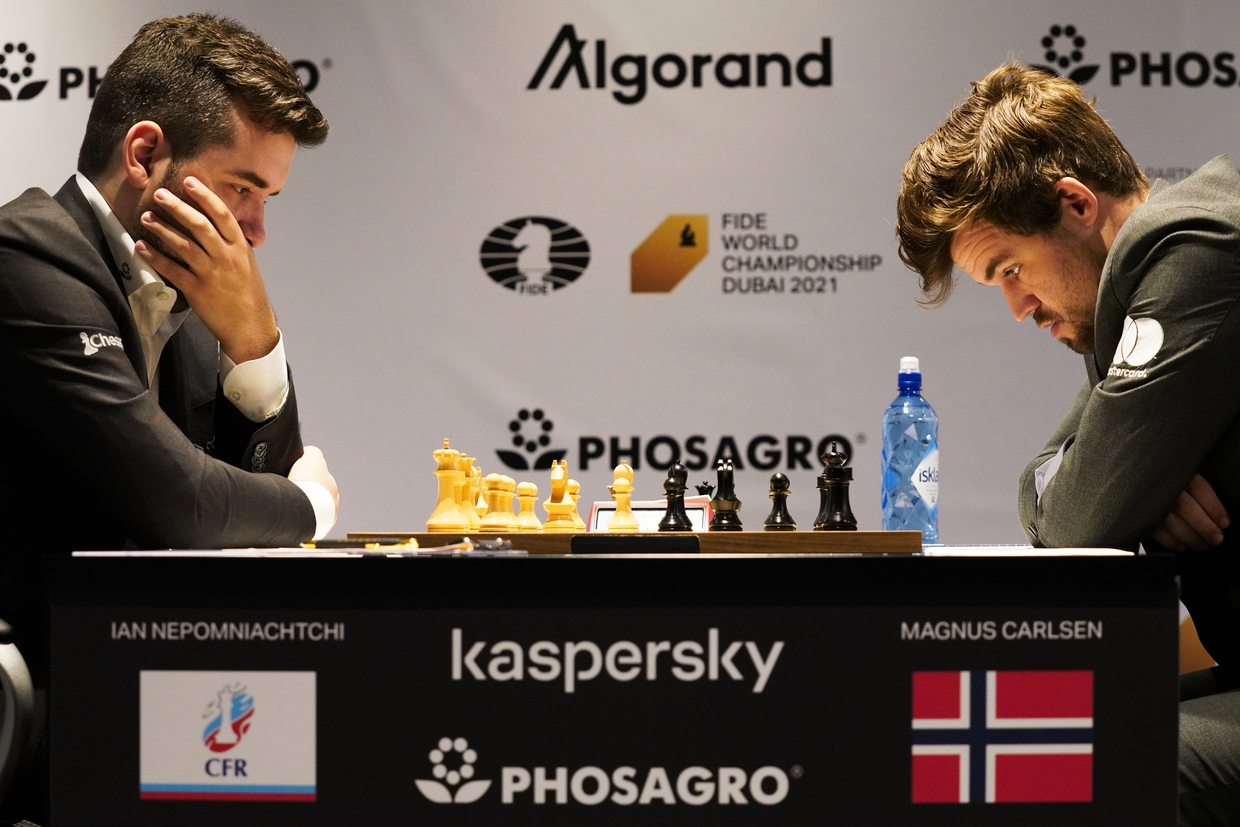
Ian Nepomniachtchi of Russia, left, and Magnus Carlsen of Norway, right, compete during the FIDE World Championship at Dubai Expo 2020 in Dubai, United Arab Emirates, Friday, Dec. 10, 2021.
Stanford University researcher Robert Sapolsky, one of whose fields of study is stress in primates, believes that “grandmasters sustain elevated blood pressure for hours in the range found in competitive marathon runners.” Some chess players lose a noticeable amount of weight during competitions, sometimes as much as 4-5 kg during a ten-day tournament.
Russian grandmaster and former world champion Anatoly Karpov reportedly lost about 10kg over the five-month-long World Chess Championship match in 1984 against Garry Kasparov. Much as a boxing referee may halt a bloody slugfest to save the fighters from serious injury, the 1984 contest was called off after 48 games, with the head of the international chess federation saying that the match had “exhausted the physical, if not the psychological, resources of not only the participants but of all those associated with the match.”
“He looked like death,” grandmaster and commentator Maurice Ashley recalled about Karpov’s appearance.
The format of requiring six wins to clinch victory in the match – meaning an open-ended number of games would be needed – was abandoned after the 1984 event, which saw 40 of the 48 games end in a draw.
Applying supercomputers to an ancient game
Ever since the Deep Blue chess computer defeated world champion Garry Kasparov in a match in 1996, computers have played an increasingly important role in chess. These days, the most powerful chess programs – called ‘engines’ – are capable of defeating even the top humans. Elite players run extensive computer analysis on chess positions and use engines to develop massive databases of opening moves and responses to parry common opening setups played by their opponents.
Because the number of possible moves in a chess game exceeds the number of atoms estimated to exist in the universe, powerful computers are much more efficiently able to parse through the myriad of possible transformations of any given chess position.
Computers are now an essential component in the toolkit of even amateur players, but the pros have taken it much further, employing supercomputers and sophisticated AI-powered engines.
Nepomniachtchi has been at the forefront of taking advantage of such capabilities. Prior to the 2020-21 Candidates Tournament, Nepomniachtchi’s team reached out to the researchers at Moscow’s Skolkovo Institute of Technology in order to adapt a number of existing chess engines for an AI-based supercomputer cluster.
Russia’s Ian Nepomniachtchi competes against Norway’s Magnus Carlsen (unseen) during Game 2 of the FIDE World Chess Championship Dubai 2021 on November 27, 2021.
The researchers agreed to help and allocated the Zhores supercomputer for his use. Zhores was designed for scientific research into machine learning and artificial intelligence but was adapted to allow Nepomniachtchi to evaluate tens of millions of chess positions per second.
After winning the 2021 Candidates Tournament, the Russian grandmaster credited the cutting-edge machine for augmenting his preparation in the opening phase of the game.
“It can’t harm my chances,” he said. “And this particular supercomputer, because it is a huge data center which can be used for scientific research, is hopefully more effective than others.”
Of course, top-level chess being fiercely competitive, all the best players have access to something similar. However, having a computer that can calculate faster and potentially see deeper than others offers the possibility of developing some kind of surprise in the opening. Given the extremely small margin of error in elite games, which are played on a knife’s edge, a well-planned novelty can be employed to devastating effect.
“You’re more sure that your analysis is good when you see 500 million node positions than, say 100 million,” Nepomniachtchi said.
So who is expected to win?
The majority of the chess commentators see Nepomniachtchi and Ding as fairly evenly matched.
Financial Times chess writer Leonard Barden called Nepomniachtchi’s recent career record “slightly more convincing” and expects the Russian to win.
Former world champion Garry Kasparov called both “very good players” and said picking between the two was “a very, very close call” before concluding that “Nepo [Nepomniachtchi’s nickname] has a slight edge though Ding is more stable than Nepo.”
The betting odds, according to Forbes magazine, are roughly 50-50.
From ice hockey to gymnastics, Russian athletes have created numerous signature moves down the years
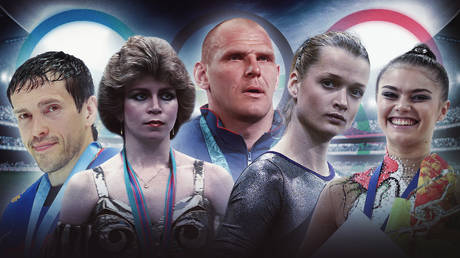
Russian athletes have undoubtedly made their mark on sports worldwide – so much so that some moves in their chosen disciplines have been named in their honor because of the way they popularized or introduced them. Here, we look at five sports moves named after Russian stars.
‘The Datsyuk Flip’ – ice hockey
Known as the ‘Magic Man’ for the way he handled his stick to pull off some unfathomable moves, Pavel Datsyuk was one of the biggest names in hockey in the 2000s and enjoyed a 15-year career in the elite NHL with the Detroit Red Wings before returning to his homeland.
Datsyuk will forever be a legend in the Motor City for his contributions to Stanley Cup titles in 2002 and 2008, but his participation on this list came after heroics in 2010.
Taking the first shot of a shootout against the Red Wings’ bitter rivals the Chicago Blackhawks in a January regular season game, Datsyuk made a mockery of opposition goaltender Antti Niemi.
Gliding up to the Finn down the middle, Datsyuk did a slight ‘dirty dangle’ that he was famous for, then quickly flicked his wrist to make it appear as if he would backhand his effort. Instead, the Russian scooped the puck with the inside of his stick into the net.
Datsyuk’s audacity understandably sent the Joe Louis Arena into rapture, as well as his teammates. “They can’t believe it on the Red Wings bench,” said one elated commentator. “I don’t think I’ve ever seen a slow-mo play like that.”
While Niemi and the Blackhawks had the last laugh that season as he became the first Finnish goalie to win the Stanley Cup, he is often remembered for being on the wrong end of Datsyuk’s trick shot.
The move became immortalized as the ‘Datsyuk Flip’, with hockey enthusiasts attempting to pull it off on the popular NHL video game to this day.
On a side note, the ‘Datsyuk deke’ wasn’t too shoddy either. Again produced in a shootout, it led one pundit to ask: “How many does he have in his repertoire?”
Svetlana Khorkina burst onto the global stage with a pair of silver medals at the 1994 World Championships in Brisbane, not long after her 15th birthday. Two years later, she enjoyed gold-medal success in the uneven bars at the Atlanta Olympics, bouncing back brilliantly after suffering initial disappointment with a 15th-place finish in the all-around final.
The comeback ushered in one of the most revered artistic gymnastics careers of all time, with further high points including another Olympic gold medal and 20 World Championship medals as Khorkina became the first gymnast in history to win three all-around world titles.
Khorkina’s main specialties were the uneven bars and balance beam, and she left a legacy with at least nine moves named after her mainly in those disciplines, in addition to a few spread across floor exercises and the vault.
The first couple – the Khorkina and the Khorkina 2 – come in the uneven bars and involve half-turn hangs. In the former, Khorkina started with a back uprise and then made a straddle flight over the high bar. In the latter, she had inner front support on the low bar, formed a clear hip circle to handstand, then impressively half-turned in full flight to hang on the high bar. There is another move called the Khorkina-Chow or Chow-Khorkina, which was first performed by Amy Chow and is a Stadler one-and-a-half pirouette.
In the 1, 2 and 3 balance beam moves named after her, Khorkina dismounted the apparatus and performed either a full twist, a gainer two-and-a-half twist, or gainer triple twist. In the Khorkina 1 and 2 moves on the vault, there were also plenty of twists and turns with ‘the Khorkina’ in the floor exercise similarly involving a hop with one and a half turns.
Four of these skills are currently listed in the Code of Points (CoP), with Khorkina previously holding the record for the most eponym moves (nine) before some of them were removed ahead of the 2022-2024 quad as part of a regular CoP update.
‘The Besti Squat’ – figure skating
Natalia Bestemianova was a Soviet figure-skating icon who, while overseen by legendary coach Tatiana Tarasova, made her name in the 1980s alongside her partner Andrei Bukin as a four-time world and five-time European champion.
After suffering silver-medal disappointment at the 1984 Winter Olympics in Sarajevo, she finally struck gold in Calgary four years later.
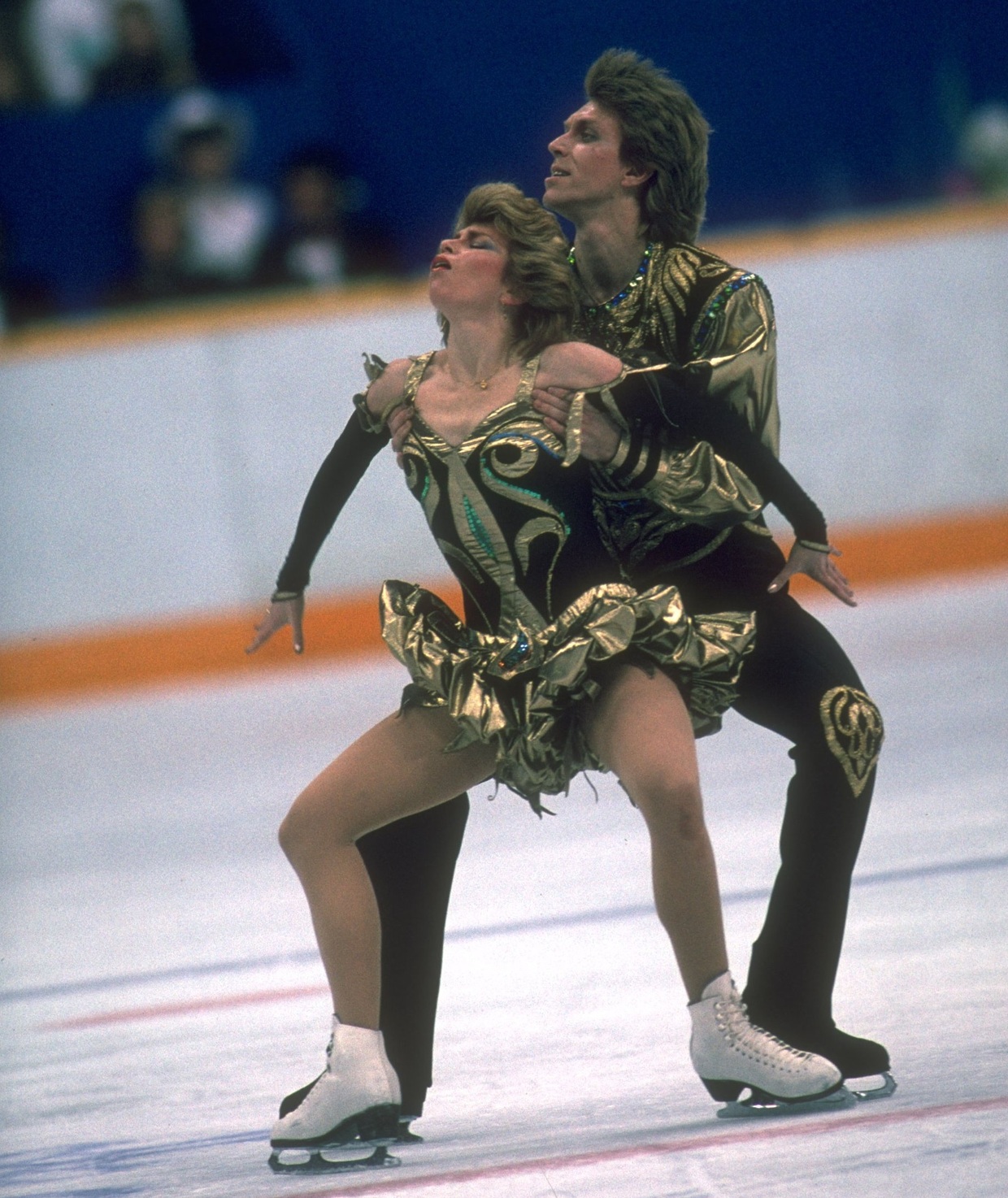
It was throughout 1988 that ‘the Besti Squat,’ unofficially named after Bestemianova, gained prominence as she used it repeatedly in her free dance with Bukin.
The move resembles the spread eagle, given that the skater who executes it glides along an edge with both skates on the ice.
The toes are turned out to the sides with the heels facing one another, and the knees are then bent outwards to a squatting position with the torso upright and thighs parallel to the ice.
Bestimianova, seen here at the 1998 Winter Olympics, made use of the move during a glittering career.
While ‘the Besti Squat’ has become a popular move still used four decades later, not everyone approved of Bestemianova’s performances at the time. Reporting from the 1988 Winter Games, the New York Times claimed that Bestemianova and Bukin’s free dance program “suggested they might take the prize for vulgarity as well,” and that the endless debate as to whether ice dance is sport or art had come to a rest.
“Her aggressiveness did not agree with a submissive image and the pair’s overall harsh style made no sense of the spliced-in moves – especially the spread eagle or plie,” it was stated.
Given that the routine landed her gold, however, it is doubtful that Bestemianova, who later became a TV personality on the Russian equivalent of ‘Dancing on Ice,’ cared too much.
The Moscow native was perhaps ahead of her time, with out-of-touch critics falling wide of the mark.
‘The Karelin Lift’ – wrestling
Known as the ‘Russian Bear’, ‘Russian King Kong’, ‘the Experiment’, and ‘Alexander the Great’, Aleksandr Karelin retired in 2000 widely considered to be the greatest wrestler of all time – and among the most dominant athletes ever seen in any sport.
Karelin scooped gold at three consecutive Olympic Games from 1988-1996 and put together a monstrous 887-2 record. He claimed silver in his last Games in Sydney in 2000.
Such was Karelin’s dominance, there were inevitable claims that he used PEDs – although the athlete himself put his phenomenal record down to something else. “No one can completely believe that I am natural. The most important drug is to train like a madman – really like a madman. The people who accuse me are those who have never trained once in their life like I train every day of my life,” he once said.
Given his undisputed reign at the top of his sport, it should be no surprise that Karelin had a move named after him. Known as the ‘Karelin Lift,’ it saw him hold his hapless opponents in the air with his enormous reach and then body-slam them into the mat.
The reverse body lift frequently saw Karelin awarded five points when executed properly, which was the maximum in the sport. The move started while his foe was lying flat on his back on the mat. Once wrapped up in Karelin’s grasp, opponents found it impossible to wriggle free from a grip described as “anaconda-like.”
While it had long been used, Karelin made the lift his own. He was the first heavyweight to add it to his arsenal and wowed the wrestling world by demonstrating it on opponents weighing up to 130kg (285lbs).
‘The Kabaeva’ – rhythmic gymnastics
One of the most decorated gymnasts in the history of the rhythmic facet of the sport, Alina Kabaeva won Olympic gold in Athens in 2004 after disappointment in Sydney four years earlier, where she had been widely expected to win the all-around event as the reigning world champion but made a costly error.
Kabaeva boasts 14 World Championship medals and 21 at the European Championships from the late 90s and into the 2000s, but her contributions to her discipline go beyond any silverware amassed since becoming European champion as a 15-year-old prodigy.
Kabaeva revolutionized rhythmic gymnastics by introducing new skills and moves. There are no fewer than four named after her, which have been given Roman numerals to distinguish them.
The ‘Kabaeva I’ is a ring leap she performed with both legs, but the ‘Kabaeva II’ is arguably her most famous, involving a backscale pivot from a standing or grounded position.
Kabaeva was the first to perform the backscale pivot, but her other two moves (the ‘Kabaeva III and IV’) saw her balance with support from her chest and split with hand support.
The 39-year-old, who later ventured into politics, is still known as one of the most flexible athletes to ever grace the mats, and it’s not difficult to see why after a recap of the maneuvers she brought to the continental and global stage.